product · ios
WordDrop

A minimalist, privacy-first vocabulary puzzle on the App Store. Calm where the day job is complex, and proof the same hands ship polished consumer products.
App Store privacy-first zero data collected
Cloud solutions architect at Microsoft and AWS, founder at latchkey, and the technical-sales side of every deal. 50+ engagements across Canadian government and enterprise.
worked & trained across

I build secure cloud infrastructure for a living: landing zones, compliance platforms, Kubernetes. At Microsoft today, and at AWS before that, mostly for Canadian government and enterprise.
But I spend as much time with customers as with code. I scope engagements, advise the executives signing off on them, and turn dense architecture into something a buyer actually understands and wants. That's the technical-sales side of the same job, and it's where I do my best work.
I also build products: latchkey, an AI-powered CI/CD platform, and WordDrop, a minimalist vocabulary game on the App Store. The throughline is taking something complex and making it feel effortless to use, and to buy.
Currently finishing an MSCS at Georgia Tech.
Deployed and customized AWS Service Workbench with CloudFormation, integrating EMR and SageMaker Notebooks for a Kaggle competition.
Built a full-stack React/Django app aggregating fraud data from multiple APIs, serving thousands of CIBC risk analysts.
Built a Kubernetes resource-optimization engine projected to save $2.5M in infrastructure costs, the work behind my patent.
Built a deep-learning model to predict chemotherapy side effects, optimizing for bias resilience and interpretability, later carried to publication.
Built ETL pipelines for real-time processing of terabytes of infrastructure data, integrated with Datadog for visualization.
Self-healing GitHub Actions: an agentic AI backend that surfaces cloud cost, security, and pipeline-performance insights, then fixes them.
A minimalist, privacy-first vocabulary puzzle on the App Store. Calm where the day job is complex, and proof the same hands ship polished consumer products.
A deeply unserious weekend build: type in any ETF and get an official-looking MUSK-FREE CERTIFIED™ stamp, or a damning CONTAINS MUSK verdict, on how much Elon is quietly riding along in your index fund. 100% a joke, 0% financial advice.
Prompt-build applications that deploy straight into a PBMM-aligned Azure landing zone, regulated-workload guardrails, without the wait.
A centralized security data lake, the biggest system I have built. Amazon Security Lake and Control Tower with ETL pipelines that ingest CloudTrail, VPC, Route 53, and Security Hub logs, then surface the whole estate in QuickSight for proactive threat detection.
Real-time compliance monitoring for PBMM landing zones. A SQL ETL pipeline in Athena ingests AWS Audit Manager and Config data and flags non-compliant CCCS guardrails in QuickSight for fast remediation.
Secure, scalable S3 data lakes with Lambda ETL and advanced QuickSight dashboards (NLP-powered search, geospatial mapping) for public-sector analytics, built with AWS CDK to the Well-Architected Framework.
A reusable delivery kit that automates replicating QuickSight dashboards across AWS accounts with CloudFormation, replacing an error-prone manual process and saving hours across engagements.
A cloud-native migration of a mission-critical ArcGIS Enterprise geospatial platform via AWS CDK (EC2, ASG, RDS, S3, VPC), improving scalability and cutting operational cost.
Re-platformed legacy systems onto AWS-native serverless: API Gateway, Lambda, WAF, and SAM, with modular CDK and OpenAPI-defined contracts replacing brittle on-prem stacks.
25 credentials and counting: 11x AWS Certified (incl. two Professional and two Specialty) and 4x Azure. The short version: I keep proving the depth on paper.
Started as an undergraduate research project in the Ester Lab at SFU: a deep-learning model to predict who would suffer hearing loss from cisplatin chemotherapy, built to stay interpretable and resilient to bias. The results were strong enough that the lab's PhD students carried it forward, and it was published in a peer-reviewed journal.
↗ read on ScienceDirectDuring my Data Scientist internship at RBC Capital Markets I built an engine that learns how containerized workloads actually consume CPU and memory, then right-sizes Kubernetes resource requests automatically, projected to save $2.5M in infrastructure cost. The approach was novel enough that RBC filed it as a US patent application, with me named as inventor.
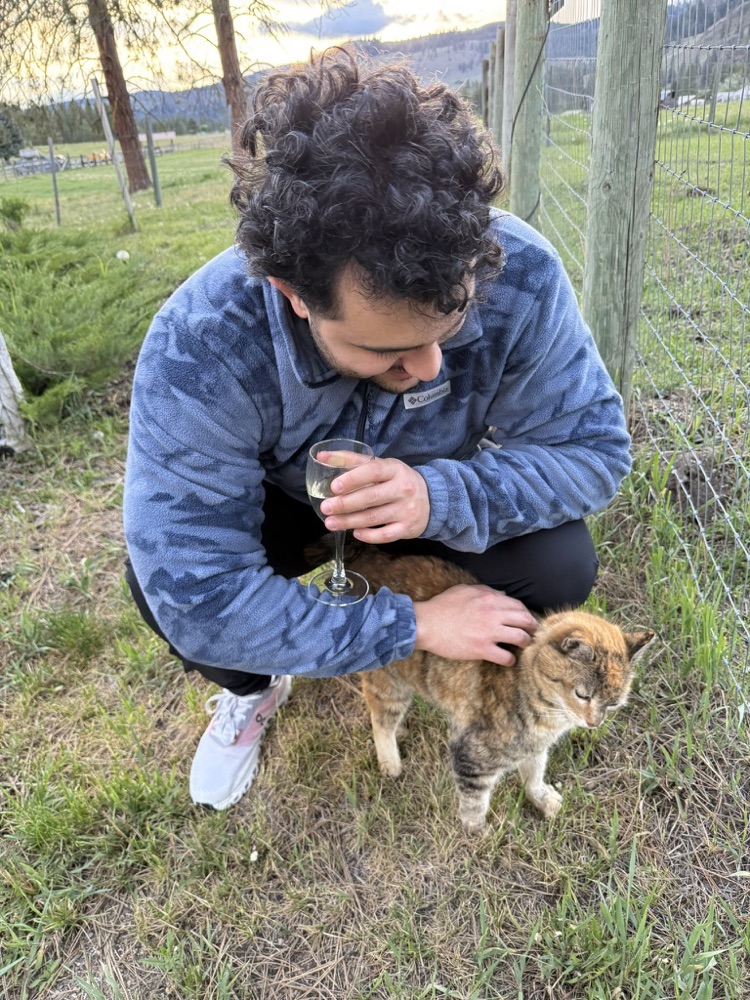
↗ view on USPTO Patent CenterWhen I'm not in a terminal, I'm almost certainly with a cat. I'm a shameless cat person, the kind who will crouch in a field to make a new friend and negotiate trust one slow blink at a time.
My own cat is a small black menace who supervises every late-night deploy from the corner of the desk. Turns out the best debugging partner is one who has zero opinions about your stack trace and full opinions about dinner.
I'm also a mechanical keyboard hobbyist, lubing switches, hunting the perfect tactile bump, and chasing that thock. Same instinct as the rest of my work, honestly: take something most people never think about and obsess over making it feel exactly right.
$ uptime · powered by espresso, a purring code reviewer, and a very loud keyboard